From a boyhood fascination with painting and woodwork to a career spanning the V&A and the valuations department at Christie’s, Leo Vaughan Williams has long been immersed in the world of fine art and furniture. Raised in Jersey, he attributes his early inspiration to his mother’s love of art and design – and her friendship with the eminent art advisor, scholar and curator Philip Hewat-Jaboor, chairman of Masterpiece Art Fair.

Early influences and a life in art
‘Philip was enormously knowledgeable,’ says Leo. ‘During his lifetime, he built up an ex-traordinary collection of 18th- and early-19th-century furniture and objets d’art. His passion for craftsmanship and design ignited my own.’
At Christie’s, Leo specialised in early-19th-century furniture and works of art, before pro-gressing to designing pieces himself. ‘Since leaving Christie’s nearly 30 years ago, I’ve been advising clients on interiors and their collections of furniture and art across all periods. It’s what’s now often referred to as ‘cross-collecting’,’ he says.


in eye-catching magenta mohair velvet, is an Amy Somerville design. - Andreas von Einsiedel -

A Wiltshire farmhouse reimagined
While he’s reluctant to call himself an interior designer, his business encompasses interior and furniture design, and art advice. Influences such as William Beckford, Thomas Hope and Sir John Soane inform Leo’s own furniture, while his most recent collection is inspired by Moroccan architecture and colours.
Leo’s knowledgeable yet irreverent approach to design is illustrated in his own home: an 18th-century farmhouse in Wiltshire, transformed by colour, pattern and art into a cosy yet dazzling visual treat. He and his wife Sarah bought the house four years ago, drawn to its good ‘bones’ and rambling garden.
At the front, the garden slopes down to a bourne, which dries up in the summer, and at the rear, a path winds towards the orchard of mature fruit trees and a charming old studio, tucked behind a hedge. The couple – who have 18-year-old twins – have spent most of their married life in Wiltshire. ‘It’s a lovely part of the country. The older houses are mostly built of local limestone, and nearby Marlborough and Bath have a lot to offer,’ says Sarah, who works in PR with clients in the interior design world. ‘We both find it hard to resist the chal-lenge of updating period country properties, so we have moved several times,’ she admits.

Colour, character and creative flair
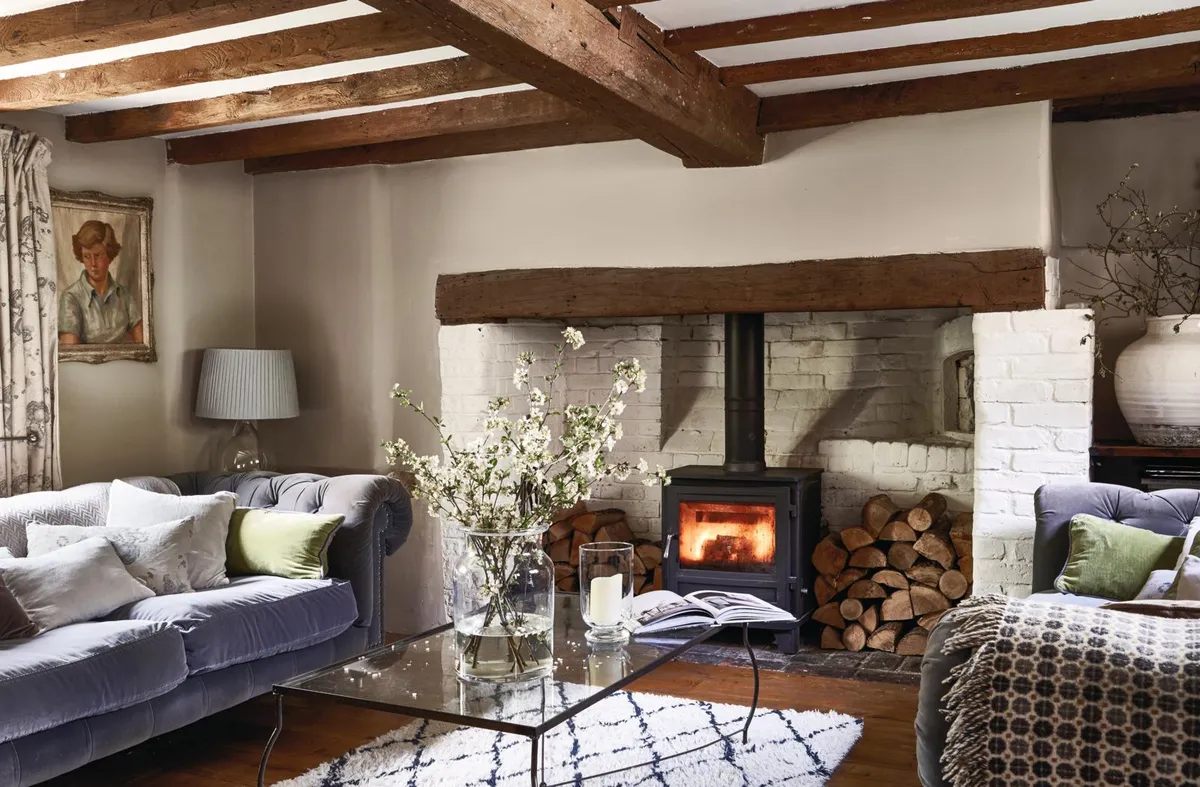
The layout of the ground floor is suited to family life, with the two rooms at the front of the house providing a sitting room and a study, while a room overlooking the garden at the back serves as a family room for the children and their friends. The glow of the wood-burning stove fitted into the fireplace casts a cosy light over both rooms on chilly evenings, as do the jewel-like colours of the rugs and assorted cushions and fabrics. This rainbow effect cre-ates a welcoming sense of bohemian informality.
Across the hall, flamboyant fruity wallpaper adorns the walls of Leo’s study. ‘It’s where I do all my working drawings for room layouts and furniture,’ he says. ‘I sometimes like to call it my kunstkammer – the German word that describes a retreat where one is surrounded by treasured books, art and objets.’


In one corner sits a contemporary Amy Somerville chair, upholstered in magenta mohair vel-vet – the antithesis of a conventional fireside armchair. Behind it are purple bookcases, de-signed by Leo to incorporate Moorish ogee-shaped pelmets, which he then painted and gilded himself.
Alongside his own furniture designs, examples of decorative paintwork can be seen throughout the house – from the trompe-l’œil panels in the sitting room to the lampshades in the main bedroom. ‘I did a course in decorative paint finishes at Master the Art and get my brushes out at any opportunity,’ Leo says enthusiastically.


A kitchen designed for gathering
The farmhouse kitchen, which came complete with an AGA, was given a facelift by means of Moorish-style cupboard doors, designed by Leo and then painted green. A central island unit, with a work surface of faux porphyry and lapis lazuli, takes inspiration from a 17th-century pietra dura tabletop. ‘I love porphyry and had a lot of fun drawing out the design and then painting it in a faux finish,’ says Leo.

An alteration that vastly improved family life was the demolition of an old lean-to green-house beside the kitchen. It was replaced with a light-filled extension, long enough to ac-commodate the family’s treasured nine-and-a-half-foot dining table, inherited from Sarah’s father.
‘Every house of ours must have a room large enough to fit that table, and the set of 14 Re-gency dining chairs, each with beautiful needlepoint seats, stitched by my mother during long flights,’ says Leo. ‘It’s a lovely way to remember both of our parents.’